08.2025
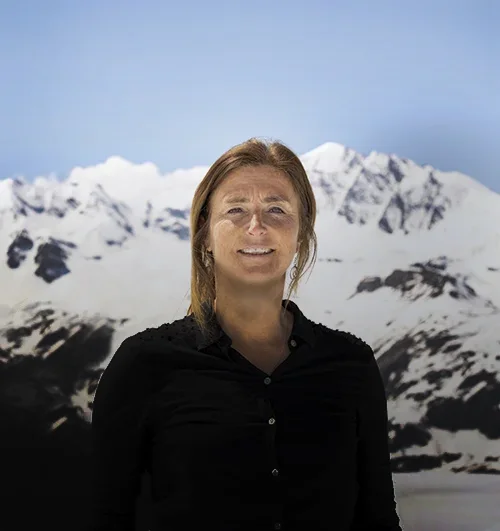
AlpineX is developing cutting-edge Direct Air Capture (DAC) technology in the Alps, leveraging the unique conditions of high altitude to boost efficiency. We spoke with Lucile Voiron, AlpineX’s new CTO and a seasoned expert in scaling hydrogen and clean tech.
What’s interesting about AlpineX’s technology:
What makes AlpineX’s approach different is the altitude advantage.The materials we’ve developed — Metal-organic frameworks (MOFs ) — work better and more efficiently at low temperatures and low humidity, which you naturally get at high altitude. In the lab, adsorption rates have shown to double compared to typical DAC. We can also capitalize on the unique concentration of the sunshine to help power the DAC, providing solar energy (PV) efficiency that is 3 times more intense than typical PV at lower altitude.
What’s unique about the material used?
The MOF we have developed is highly specialized for CO₂ capture under low partial pressure conditions, which makes it particularly effective at high altitudes where CO₂ concentrations are lower. It has been tailored to maximize selectivity for CO₂ (i.e. ignoring other gases), and has a quick capture and release cycle so the system can work continuously and efficiently. The regeneration process requires very little heat and uses no chemicals, pollutants or water.This translates to lower energy costs during the regeneration phase.
Tell us more about your prototype:
The prototype will launch in 2026. It’s the size of a 20-foot shipping container and is modular, allowing us to adapt and scale the design based on what we learn during testing. Supported by the local Mairie (townhall), it will be located in Val d’Isère and is designed to capture around one ton of CO₂ per year. We’ll be testing it for six months, adjusting parameters like airflow and pressure to find the most efficient setup.
Which elements are you most confident about in the pilot? And what will you test?
We know the theory works. Now we need to see it in action. As I mentioned we’re highly confident in the performance of the MOF itself. The adsorption/desorption cycle has also been validated at a small scale, demonstrating that the material maintains its performance over multiple cycles without significant degradation. Now we want to test the full integration of the process in real-world conditions. The goal is to confirm that the complete system can operate continuously and efficiently while maintaining stable capture rates over time.
Let's Shape the Future of
Direct Air Capture.